Indeterminacy in music and life
Written by Jordan Elias, MT-BC
Why tolerating uncertainty is a musical skill, and how to practice it
On Not Knowing
There is a particular kind of stress that has less to do with what is actually happening but rather what might. Things like waiting for a response after an interview, or for test results. A feeling that a relationship dynamic subtly changes but you can't say how. Putting on a social mask to make conversations more predictable, at the expense of your energy and authenticity. Uncertainty is an important and under-acknowledged source of stress and anxiety.
Anxiety is often framed as though it is about fear, and in part it is. But what often drives anxiety is the uncontrollable aspects of life. Psychology research consistently shows that people rate the anticipation of an unpleasant event as more distressing than the event itself. Uncertainty about whether something bad will happen is often harder to tolerate than the outcome itself. I don’t think this distress is irrational, it’s a nervous system response that we evolved while scanning our environments for threats.
At the neurological level, what we are scanning for is safety, and safety requires some degree of predictability. An infant needs to know that when they cry, someone comes. An adult needs continuity in relationships, income, health, and identity. Without that predictability, all available cognitive resources turn to the question of what comes next.
The desire for control, then, is a survival strategy that served humans well for a very long time, and continues to serve us in many situations. But there is sometimes a mismatch between the need for predictability and the actual availability of it. And it is where anxiety springs up most intensely. There are strategies to manage it; some of these are adaptive like gathering information, seeking support, breaking large challenges into smaller actionable steps. Some are maladaptive: avoidance, which delays the discomfort but enlarges it; reassurance-seeking, which soothes momentarily but reinforces the belief that the uncertainty was truly dangerous; rumination, which feels like problem-solving but is actually the mind spinning its wheels on a question that has no answer yet. A common theme with these less adaptive strategies is that they treat uncertainty itself as something to be eliminated.
A shift from uncertainty as threat to uncertainty as condition might be worth making. Not all uncertainty is dangerous. Hindsight is 20/20 and we do not yet know our future because it has not yet resolved. This is not a problem to be solved. It’s a feature of being alive.
I know it’s easier said than done though. The therapeutic work around uncertainty is not primarily cognitive. It may be true that things will be fine but it doesn’t change the bodily response. What can is practice: low-stakes encounters with not knowing the outcome, in an environment safe enough to stay present rather than flee. This is where music comes in. And in particular, I have come to understand my relationship with uncertainty through the indeterminate and chance-based compositions of artists like John Cage, Pauline Oliveros, and Steve Reich.
Chance
John Cage, maybe most famous for the composition 4’33”, was interested in what happens when you remove the composer's intention from a piece of music. In many of his compositions he used chance operations like rolling dice and consulting the I Ching to determine what notes would occur, in what order, and at what volume.
“Wherever we are, what we hear is mostly noise. When we ignore it, it disturbs us. When we listen to it, we find it fascinating. The sound of a truck at fifty miles per hour. Static between the stations. Rain. We want to capture and control these sounds, to use them not as sound effects but as musical instruments. Every film studio has a library of "sound effects" recorded on film. With a film phonograph it is now possible to control the amplitude and frequency of any one of these sounds and to give to it rhythms within or beyond the reach of the imagination. Given four film phonographs, we can compose and perform a quartet for explosive motor, wind, heartbeat, and landslide.”
- Cage
Clinically, I find this idea useful. So much anxiety is rooted in an attempt to control, to predict, or to prevent the unwanted outcome. Cage's response to this philosophically, and I would argue therapeutically, was not to learn to control better. It was to practice letting go of the illusion that control was ever possible. I get how this can veer toward a nihilistic thinking, but I think it's something that looks like curiosity.
“What is more angry than the flash of lightning and the sound of thunder? These responses to nature are mine and will not necessarily correspond with another's. Emotion takes place in the person who has it. And sounds, when allowed to be themselves, do not require that those who hear them do so unfeelingly. The opposite is what is meant by response ability. New music: new listening. Not an attempt to understand something that is being said, for, if something were being said, the sounds would be given the shapes of words. Just an attention to the activity of sounds.”
- Cage
Try this: find a quiet place. Or don't. Any place will do. Your kitchen while the kettle boils. The street outside your front door. Set a timer for 2 minutes. Close your eyes. Your only task is to hear what is already happening in the room. Don't name it or judge it. Just receive it. When it ends, write down one word for what you noticed. Optionally, open a voice memo app. I would recommend MOTIV Audio as it lets you record in WAV or MP3 formats. Set it down, and record. Then just be in the space and listen as its recording. Afterwards, put on headphones and play back the recording. You will almost certainly notice things you didn’t consciously hear while present.
If you’re interested in learning more about him, I recommend this documentary, A Year With John Cage by Frank Scheffer.
Deep Listening
The composer, accordionist, and queer feminist icon Pauline Oliveros called her practice Deep Listening, a phrase she used both as a description and as a formal technique, eventually developing it into a performance philosophy. Where Cage was interested in removing the composer's ego from the work, Oliveros was interested in going deeper into the body and into the experience of the listener.
One of her ideas that I think about is the distinction between focal and global attention. Focal attention is a spotlight where global attention is the ambient field of everything else in the peripheral, the felt sense of a space. We are most of the time in focal mode. And anxiety grows when attention is narrowed onto some particular threat or uncertainty.
In clinical practice, I've found Oliveros's framework useful; working on expanding from focal to global attention opens up our listening and presence.
I would recommend watching her 2015 TED Talk.
Try this: take a ten-minute walk without headphones or a destination. As you walk, consciously try to hear the furthest sound you can detect (traffic, wind, a distant voice). Hold that far sound while also being aware of the closest sound (your own footsteps, breath). Stretch your hearing to hold both at once. Notice what happens to the sense of urgency or anxiety in your body as you do.
Repetition
Composer Steve Reich's early minimalist compositions play with what he called phasing. When two identical melodic patterns are played simultaneously, but one very slightly sped up, the patterns drift apart overtime, creating unintended harmonics and syncopation, then slowly converge again. Composition as a process playing out.
Reich has talked about this as learning to listen to what the music itself wants to do, rather than imposing a structure upon it from outside. Therapeutically, I think about feeling stuck in rumination, of cycling through patterns of feelings, or the feeling that things shouldn’t be as they are.
One narrative is that repetition means nothing is changing. Reich's music suggests the pattern is never truly identical to its last iteration, that our position is influencing our perception. The piece is going somewhere even when it sounds like it's standing still.
Try this: hum or play a single, simple phrase. Four or five notes, or even just one note held and released repeatedly. Do this for a minute with no intention to vary it. Let your attention rest lightly on what does change anyway: the quality of the sound, your breath, the feeling in your chest, the room around you. Afterwards: what moved, even though you weren't trying to move it? Did something in the body soften, or something in the breath shift?
For the 1965 piece, ‘It’s Gonna Rain’, Steve Reich made two copies of the same recording, looped them and played them simultaneously on separate tape machines. Because they ran at slightly different speeds, the loops fall in and out of phase. Rhythmically it creates very interesting moments, but in some way I think the sentiment changes, the relationship to the words I find shifts throughout. Listen to It’s Gonna Rain by Steve Reich.
Experiment with phasing yourself
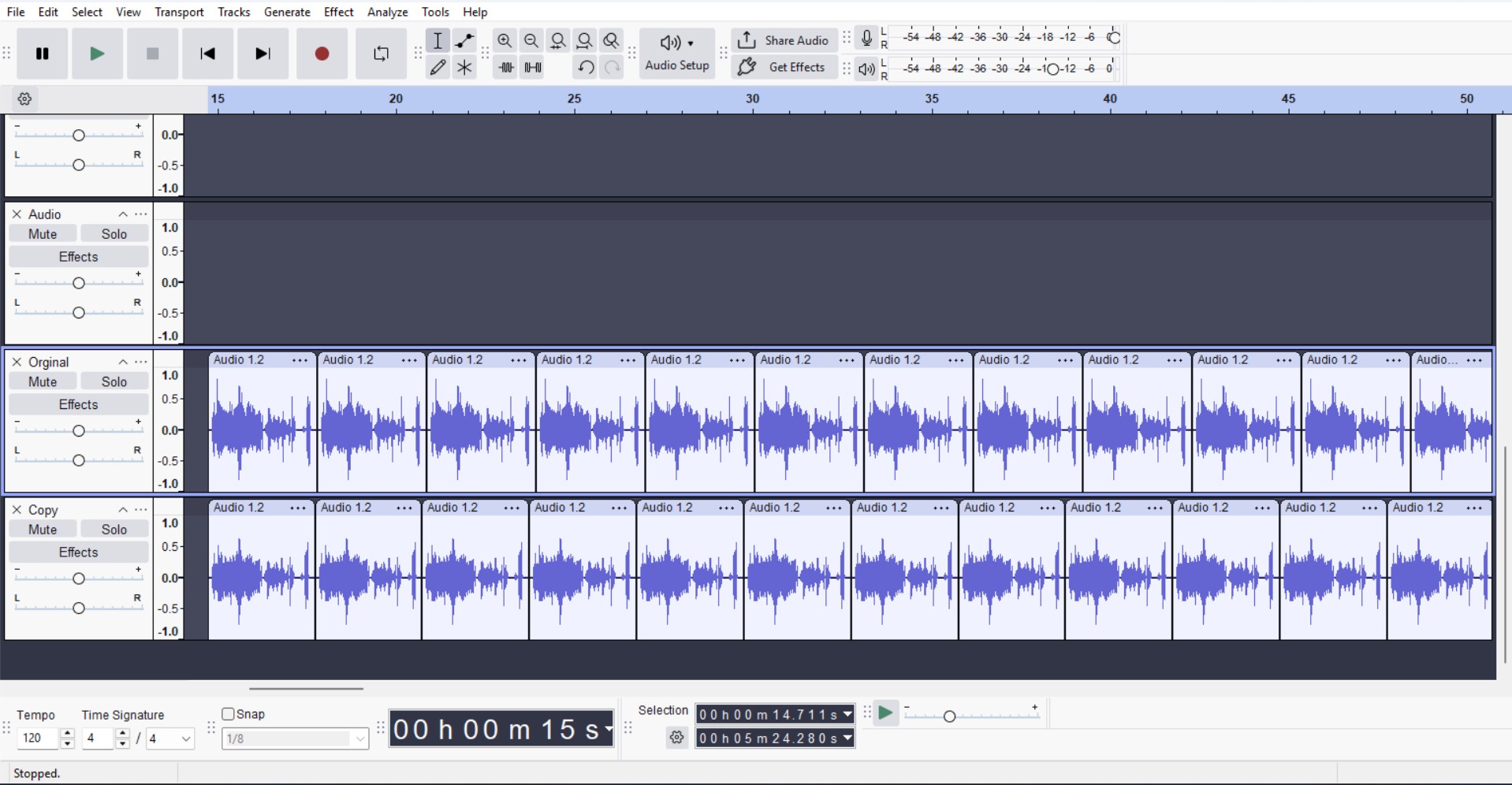
The steps of this exercise are to demonstrate how you can try this phasing effect with just your computer. The instructions are specific to Audacity, a free software for editing audio, but you can adapt them for any DAW. If you don’t already have it, you can download Audacity for free: audacityteam.org
And I think it’s great to donate what you can to open source projects that you find useful.
Instructions
- Audio file: start by opening a new Audacity project and record something. Sounds around your flat, yourself speaking, anything really. A single word or phrase is nice. Alternatively, you can find an existing audio file, field recording, or voice note you find interesting. Try something with spoken word. Or try natural sounds like rain. A single sustained instrumental note can also produce interesting rhythms. Make sure it’s accessible as a WAV file somewhere on your computer, then go to File > Import > Audio. Your recording appears as a waveform. If it's long, you'll want to select and isolate a short clip first. Something like a single word or phrase. Or 1–5 seconds of something interesting. Click and drag to highlight your selection, then go to Edit > Split New to move just that clip to a new track. Mute or delete the rest of the original track.
- Repeat the clip: select the clip, it will be highlighted in blue. Then go to: Effect > Special > Repeat. 100 times would be plenty but this can be varied depending on the length of the clip. Press Play and your short clip will repeat continuously for the number of times you specified. Listen to it for a bit. Notice whether repetition changes your experience of it. Things you didn't hear at first might begin to emerge. This is already compositionally interesting before you've done anything else.
- Duplicate the track: select only the first clip, go to Edit > Duplicate. You now have a new track with a copy of the original, and starting at the exact same time.
- Change the speed of the duplicate very slightly: right-click the duplicate audio clip, go to Pitch and Speed > Clip Speed. Set the percentage change to between +1% and +3%. Then do step 2 for this new clip, repeating it as many times as you’d like.
- Play both tracks together and listen: at first the two tracks sound almost identical. Then over time, they begin to drift. Echoes appear and rhythmic patterns emerge that weren’t in the original. Maybe it’s uncomfortable. Or maybe it’s silly. Let the tracks run without touching anything. How did it change what you felt about the original recording? Does the meaning of the words shift too?
- Save it and export it: experiment with variations first. Try shorter or longer clips. Change the speed. If you find a version you want to keep: go to File > Export > Export as MP3 (or WAV).
If you try this and would like to share it, please get in touch, I would love to hear it!
Music Therapy
Conventional cognitive approaches to treating anxiety focus on challenging the beliefs behind the anxious thoughts. Is this thought accurate? What is the evidence? These are useful tools but they operate at the level of the content, or the ‘what’.
What I find in chance music, process music, and indeterminate compositions is something different: a reframing of our relationship to uncertainty. The idea that uncertainty can be tolerated, inhabited, explored, and listened to. Or that both can be true at once.
And music, uniquely as a therapeutic modality, can put that into practice rather than discussing or rationalizing those feelings. The play between uncertainty and predictability is what makes music interesting. Improvisation is a controlled experiment in not knowing what comes next. Listening is a practice in building expectations toward a resolution and being pleasantly surprised by the unexpected.
Music therapy often looks to music's ability to soothe, to energize, to express, and those are powerful effects. But there is another dimension available, and experimental composers have explored it in very interesting ways.
This is some of the work I like to explore in therapy. And there are so many more pieces to take inspiration from. Using found sounds, field recordings, and voice memos to experiment in therapy sessions with some of these chance-based operations. Finding interesting or meaningful audio clips, then using dice or a random number generator, randomizing their order. Or randomizing how much the clips overlap. Or their volume, duration, and panning. Recording a belief statement about oneself and seeing what a random process does to the words and the weight they carry.
If This Resonates
Try one of the experiments. Bring it into your daily routine. Note what it does to your feeling of not-knowing.
If you're curious about what music therapy grounded in these ideas looks like in practice for yourself or someone you care about, please feel free to reach out about an initial consultation to explore whether it might be a fit. I particularly work with musicians facing creative blocks, neurodivergent individuals, and people navigating illness, trauma, and loss. Music experience is not required. You can connect with me through the contact page.
Book a free intro callIf you're a fellow music therapist interested in the intersection of ‘experimental’ music and clinical practice, I'd genuinely love to hear from you.
Book recommendations if you’d like to discover more on this topic:
- Silence – John Cage
- Deep Listening – Pauline Oliveros
- Oblique Strategies – Brian Eno